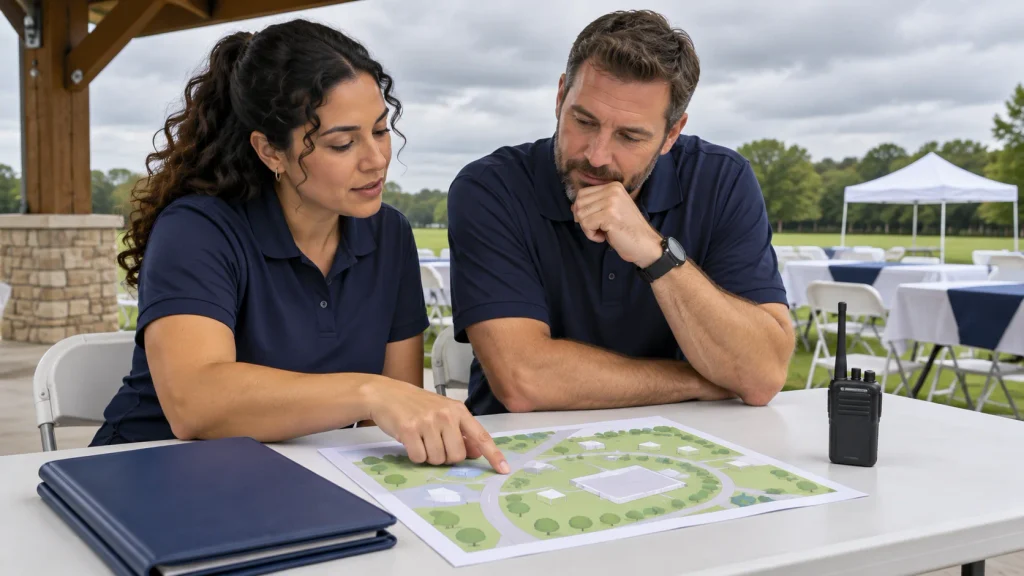
The open house has volunteers, a food order and a social post ready to go. The weather conversation is still “We will keep an eye on it.” That phrase leaves several unanswered questions: who watches, which information they use, who can change the event and how everyone learns about a decision.
A short planning brief can bring those questions into one place. It supports the event’s actual safety plan and the direction of local officials; it does not replace either. The National Weather Service’s Event Ready materials are a useful starting point for organizers working with public safety partners.
Describe the event that is really being planned
Write the location, date, setup period, public hours and teardown period. Note whether people will be outside, in a building or moving between both. Include vendors and volunteers in the discussion, not just ticketed or registered visitors. A public drop-in event can have different communication challenges from a meeting with a fixed attendee list.
Mark facts that are still unknown. An estimated attendance figure is not a verified shelter capacity. A nearby building is not automatically available to event guests. Identifying those gaps early lets the appropriate owner answer them before promotion creates expectations.
Name the weather-information owner and a backup
Ask who will monitor official information before and during the event and who covers that job if the person is unavailable. A volunteer managing parking, greeting visitors and answering a phone may not be able to maintain the attention the weather role needs. The organizer should agree on a workable assignment and communication method.
Record the official forecast and warning sources selected with the local public safety partner. Different weather hazards call for different preparation. Avoid reducing the whole discussion to a single weather-app percentage or a screenshot from the previous evening. Conditions and information can change during setup and teardown as well as public hours.
Take decision questions to the right people
The brief should identify who can delay, pause, relocate or cancel the event and who serves as the backup decision maker. Ask those owners to confirm the action criteria and instructions in the approved event plan. Do not invent technical thresholds because another event used them.
Discuss what happens if a planned indoor location becomes unavailable, a communication method fails or a key contact cannot be reached. These are planning questions for the event lead and responsible officials. Recording an unresolved question is better than writing a reassuring answer that nobody has authorized.
Prepare the communication before it is needed
List the channels used to reach volunteers, vendors and the public. A homepage update may help someone who has not left home; it may not reach a visitor standing behind the station. A message to staff may not reach an independent food vendor. Decide who posts or announces each update and where people can find the current event status.
Draft simple messages for a delay, closure or location change, leaving the actual decision details blank until authorized. Include the event name, the change, the time of the update and where the next confirmed information will appear. Ask about accessible communication and language needs while there is time to arrange them.
A one-page discussion sheet
| Question | What the brief should record |
|---|---|
| What is happening? | Location, public hours, setup, teardown and expected activities. |
| Who follows weather information? | Named owner, backup and official sources selected with event leadership. |
| Who decides? | Authorized decision maker, backup and reference to the approved plan. |
| How are people informed? | Staff, vendor and public communication owners and channels. |
| What is unresolved? | Each open question, its owner and the date an answer is needed. |
Keep contact details in the appropriate internal version. The public event page does not need personal phone numbers or restricted operational information. Review the brief with the people who will actually work the event; a document nobody has seen is not a shared understanding.
Close the loop after the event
At the debrief, ask whether updates reached the right people, whether contact information worked and which questions remained unclear. Assign one improvement and an owner before filing the notes. Our community-event feedback guide can help turn that conversation into a practical next step.
For broader planning contacts, begin with the emergency management directory. Equipment and supplier questions belong in a separate purchasing conversation; the purchasing resource page can help organize those. HUB911 is a directory and editorial resource, not an emergency alerting service or an event approval authority.
Test the brief with a realistic planning example
Fictional planning example: a department is arranging a Saturday open house with vehicle displays outside, a classroom presentation inside and an independent food vendor in the parking area. Public hours start at noon, but volunteers arrive earlier to set up. A weather-related change could therefore affect several groups before a member of the public reaches the event.
The organizer asks each activity owner to confirm when people arrive and which communication route they monitor. The food vendor needs a direct operational update, while visitors who have not left home need an accurate public status page. The classroom’s availability and capacity are referred to the responsible facility and safety officials; the organizer does not assume that everyone outside can simply move there.
The brief identifies the approved decision maker and the person responsible for publishing an authorized update. It also names a backup for each role. The open question is no longer “Will it rain?” It is whether the actual event plan has current information, workable responsibilities and decisions that can reach the people affected.
This example is not a safety plan for another venue. Its value is the method: describe the activities, identify the people, refer technical questions to the right owners and track unresolved items before public expectations become fixed.
Include the hours that promotion tends to forget
Public advertisements usually state when visitors may attend. The planning conversation also needs the delivery, setup, rehearsal and teardown periods. A vendor who arrives before the event lead or a volunteer who stays to load equipment may otherwise be absent from the communication list.
Ask each lead for a simple activity timeline. Record who supervises the work and how that person receives a change. Keep this in the internal brief rather than publishing private schedules or contact details. If responsibility passes to another person after public hours, make the handoff explicit.
Review planned announcements and automatic social posts as well. A scheduled “Join us this afternoon” message can contradict a later decision if nobody owns its update. The person responsible for public communications should know which channels and queued messages need attention when an authorized change occurs.
Finish by asking what a late-arriving volunteer or guest will see. An old sign, cached event listing or unanswered entrance can create confusion. Decide with event leadership how current status will be displayed and who checks it. Do not ask a visitor to infer a cancellation from silence.
Use a communication rehearsal before a weather decision
Rehearse the information path during ordinary planning time. Use a clearly identified practice message approved by the organizer, not a public emergency announcement. Confirm whether the named staff and vendors can find the current plan, recognize an authorized instruction and identify the next contact when something is unclear.
The rehearsal can be a conversation rather than a live system test. Ask the public-information owner: “If leadership changes the opening time, which page and messages do you update?” Ask the vendor lead: “Who tells the outside partners?” Ask the volunteer coordinator: “How do you reach the people already on site?” The answers reveal gaps without inventing a weather trigger.
Keep accessible communication in that discussion. A loudspeaker announcement, a printed sign and a social post reach different people. The responsible event and accessibility contacts should decide which methods are needed for the actual audience and setting. Record arrangements that have been confirmed, not just ideas that sounded useful in a meeting.
When a rehearsal identifies a missing contact or unclear approval, assign an owner and a completion date. A list of concerns becomes useful only when somebody is responsible for resolving them. Recheck the completed item with the affected person before treating the gap as closed.
Keep a decision log that survives a change of organizer
Use a short internal log for confirmed planning decisions: the question, the decision, the person with authority, the date and the related plan or message. This is different from recording every weather observation. It documents why the event’s arrangements are what they are and where the current instructions live.
For example, a record might state that the facility manager confirmed a particular public entrance for an indoor program, or that the vendor coordinator acknowledged the event-status communication process. If the arrangement changes later, preserve the earlier entry and identify the newer one clearly. Avoid leaving two different versions both labeled final.
During a change of organizer, review the outstanding items rather than forwarding a large folder without explanation. Identify the current event plan, the approved public status location, the responsible contacts and the questions that still need answers. Store restricted information according to the organization’s policy.
After the event, retain the appropriate records and use the debrief to improve the next brief. A repeat event should not inherit an unresolved assumption merely because last year’s file looks complete. The next venue, audience, staffing and official guidance may require a different discussion.
Official sources reviewed November 27, 2026: National Weather Service Event Ready Guide and NWS organized outdoor-activity lightning planning. Use the event’s approved safety procedures and current direction from the responsible local officials.